Scriptixari
GRID COLLECTION
GRID COLLECTION
- 🗂️ Digital file available after purchase
- ♾️ Long-term availability
- 🔒 Secure checkout
- 🗓️ Content updated in 2026
Self-paced learning overview
1. Problem Statement
When study tasks become larger, a learner needs not only to know separate Python topics, but also to see the connections between them. Functions, files, classes, checks, data, and helper blocks may work separately, but without an understandable scheme, they are hard to combine into one order. Because of this, code can become uneven: one part is written clearly, another has repetition, and a third is poorly connected to the rest. Learners often need a study approach where each part of the solution has its place in the general grid. Grid Collection was created to help learners see a Python solution as an organized structure where each block supports the overall logic.
2. Solution
Grid Collection teaches learners to view Python code as a grid of connected elements: data, functions, classes, files, checks, and final result. The course shows how to plan a larger task, define the roles of separate parts, and keep steady order across the whole structure. The materials help learners better understand where data preparation belongs, where the main logic should be placed, and where helper tools fit. Each module includes practical examples where separate parts gradually form a complete study solution. This format suits learners who want to work with Python more systematically and carefully.
3. What’s Inside
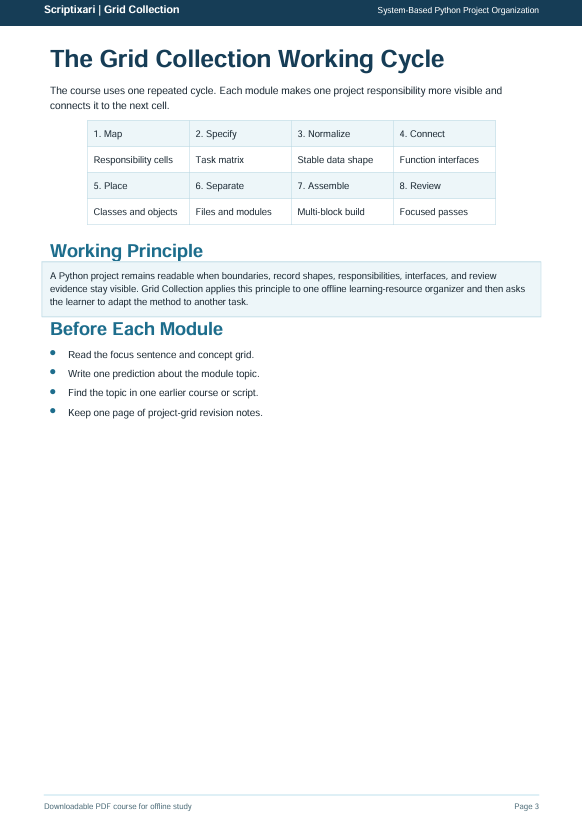
- Module 1: Grid Thinking for Code — how to view a Python solution as a grid of connected parts and define the place of each block.
- Module 2: Task Structure Matrix — how to divide a study task into stages, roles, data, checks, and expected result.
- Module 3: Data Layer Organization — how to organize data, value preparation, format checks, and information transfer between code parts.
- Module 4: Function Grid Practice — how to create a set of functions where each one has a clear role and does not repeat the work of other parts.
- Module 5: Class and Object Placement — how to decide where classes are useful and how not to overload a study solution with them.
- Module 6: File and Module Layout — how to divide code into files, modules, and helper parts while keeping the structure understandable.
- Module 7: Multi-Block Study Build — how to assemble a study example from several connected blocks: data, logic, checks, handling, and final output.
- Module 8: Grid Review Method — how to review a finished solution, find uneven parts, repetition, and places for structure improvement.
4. Who Is This For?
✅ A good fit if you...
- already have experience with functions, files, collections, and simple classes;
- want to better see the connections between Python code parts;
- want to work with multi-part study tasks;
- are looking for materials about order, structure, and solution logic;
- want to learn how to review code as one system.
❌ Not for you if...
- you are only starting to explore Python;
- you have not worked with files, functions, or collections yet;
- you are looking for a short introduction without more complex structures;
- you do not want to plan code before writing it;
- you expect material only with separate small exercises.
5. What You’ll Learn
- How to view a Python solution as a grid of connected blocks.
- How to divide a task into stages, roles, and expected results.
- How to organize the data layer in study code.
- How to create functions with separate clear roles.
- How to choose a place for classes and objects in the structure.
- How to organize files and modules in a multi-part example.
- How to assemble a study solution from several connected blocks.
- How to review finished code and notice where the structure needs improvement.
6. Purchase Return Terms
Grid Collection may include 30-day return terms when stated on the plan page during purchase. Details depend on the Scriptixari store rules and the description of the specific learning material.
7. Certificates & Credentials
After completing Grid Collection, the learner can receive a certificate connected to system-based organization of Python solutions. It reflects work with task grids, data layers, functions, classes, files, modules, and multi-part code review. The document helps mark the completion of this broader learning stage.
How are Scriptixari courses structured?
How are Scriptixari courses structured?
Scriptixari courses are divided into sequential modules with explanations, examples, and practical tasks. Each block helps learners move through the topic gradually and continue to the next part without extra confusion.
Do I need previous Python experience?
Do I need previous Python experience?
Some courses are suitable for beginners, while broader plans may work better for learners with basic code knowledge. Each plan explains who it is intended for and which starting level fits the material.
Couldn't load pickup availability
Share